AI Overview appears in a staggering 57% of Google search results pages as of June 2025. That’s a game-changer for anyone trying to gain visibility online.
When we look deeper into the data, the picture becomes even more compelling. Currently, AI Overviews appear for at least 16.85% of U.S. search queries, while 60% of Google searches never left the search engine results page in 2024. Furthermore, 52% of sources cited in AI Overviews already rank in the top 10 search results. This new Google AI Overview feature is fundamentally changing how users interact with search results and how we need to approach SEO.
However, there’s good news for content creators. Understanding how AI Overviews work can help you optimize your content to appear in these prominent positions. In fact, with the right strategy, you can position your website as an authoritative source that Google’s AI wants to feature.
In this comprehensive guide, we’ll walk you through exactly what Google AI Overview is, why it matters for your visibility, and most importantly, the step-by-step process to optimize your content for inclusion. Let’s dive in and master this new frontier of search!

What Is Google AI Overview and How It Works
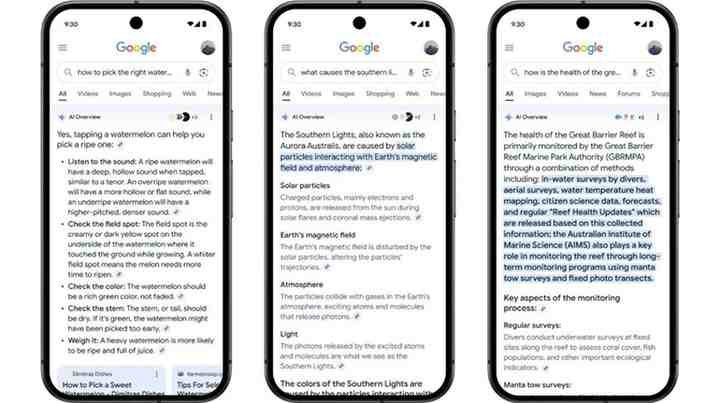
Image Source: Mashable
Google AI Overview is an artificial intelligence feature that creates concise summaries at the top of search results pages. Originally launched as Search Generative Experience (SGE) in May 2023, Google rebranded it as AI Overviews in May 2024. This innovative addition to search uses advanced generative AI to synthesize information from multiple sources, giving users quick answers to complex questions.
How AI Overviews differ from featured snippets
Featured snippets and AI Overviews serve similar purposes but operate differently. The primary distinctions include:
- Source utilization: Featured snippets extract text from a single webpage, presenting it exactly as written. Conversely, AI Overviews aggregate information from approximately five to six different websites, creating original content through Google’s Gemini AI model.
- Content presentation: Featured snippets typically contain 40-60 words, whereas AI Overviews average 169 words and occupy considerably more screen space. According to research, when both AI Overviews and Featured Snippets appear together, they consume approximately 67.1% of screen space on desktop and 75.7% on mobile
- Position and visibility: AI Overviews appear above featured snippets when both are present, pushing traditional organic results further down the page.
When and where AI Overviews appear in search
AI Overviews don’t trigger for every search query. They currently appear in 19% of all U.S. desktop keyword searches and are predominantly shown for:
- Informational queries (84.16%)
- Transactional queries (12.38%)
- Navigational queries (3.31%)
- Local queries (0.15%)
Google displays them primarily when their systems determine that generative responses can provide additional benefits beyond standard search results .
Why Google introduced AI Overviews
Google created AI Overviews to simplify the search experience, especially for complex topics. According to Google, users with access to AI Overviews search more frequently and report higher satisfaction . Additionally, these AI-generated summaries encourage exploration by prompting users to visit a wider variety of websites for complex questions .
Beyond improving user experience, this innovation represents Google’s strategic response to competitive pressure from other AI advancements, particularly OpenAI’s ChatGPT.
How AI Overviews Are Changing SEO
The AI SEO landscape is experiencing a dramatic transformation as AI Overviews reshape how users engage with search results. This shift demands new strategies for visibility and traffic acquisition.
1. Impact on organic traffic and zero-click searches
Recent studies reveal concerning trends for website owners. When AI Overviews appear, clickthrough rates for position 1 organic listings drop by 34.5%. Similarly, Amsive’s research shows an average CTR decline of 15.49%, with steeper losses of 37.04% when combined with featured snippets. The situation becomes more troubling considering zero-click searches increased from 56% to 69% between May 2024 and May 2025 . Some publishers report devastating traffic losses, with click-through rates plummeting by as much as 89% in worst-case scenarios .
2. New visibility opportunities for smaller sites
Despite these challenges, AI Overviews present unexpected opportunities. Remarkably, smaller websites with fewer than 10,000 monthly visitors receive a higher percentage of their traffic from AI compared to larger sites . Moreover, tools like ChatGPT send , versus 43.4% for larger ones 67.4% of AI traffic to smaller websites. This occurs because Google doesn’t necessarily favor established brands when creating AI Overviews. Instead, it prioritizes quality information that satisfies search intent . Consequently, even without direct clicks, appearing in AI Overviews builds brand awareness and credibility .
3. Why traditional ranking signals still matter
Regardless of these new dynamics, conventional SEO remains vital. Notably, 53.76% of AI Overview citations come directly from pages ranking in the top 10 search results . Pages that don’t achieve these positions are typically excluded entirely from AI-generated answers. Additionally, Google’s AI prioritizes content with clear structure and formatting. Pages lacking proper organization are harder for AI systems to process and often get ignored . Therefore, maintaining strong organic rankings through traditional SEO practices remains essential for AI Overview inclusion.
How to Optimize Your Content for AI Overviews
Optimizing for AI Overviews requires a strategic approach to content creation. To increase your chances of being featured as a source, you’ll need to make specific adjustments to how you structure and present information.
1. Use clear, concise answers early in the content
Place direct answers to primary questions within the first paragraph of your content. AI systems prioritize content that provides immediate solutions to user queries. This front-loading approach helps Google’s AI quickly identify and extract essential information for generating summaries .
2. Structure content with lists, tables, and headings
Organizing information in digestible chunks makes your content more accessible to both readers and AI systems. Break down complex topics using:
Properly formatted H2 and H3 tags that mirror actual search queries
Bullet points and numbered lists for presenting related information
TML tables for comparing products or features
Short paragraphs (2-3 sentences maximum) to improve readability
3. Match search intent with relevant content formats
Different query types require tailored content structures. For informational queries, provide clear definitions and explanations. For commercial queries, include detailed comparisons with specific data points . Always align your content format with the primary user intent behind the search.
4. Use schema markup and structured data
Implementing structured data significantly enhances your visibility in AI-generated results. Pages with comprehensive schema markup are to appear in AI summaries 36% more likely. Use relevant schema types like FAQ, HowTo, Article, and Product to help AI systems better understand your content’s context .
5. Improve readability and user experience
Above all, create content that’s easy to consume. Google values pages that offer strong user experiences, including fast loading times and mobile-friendly design . Use clear language without jargon and maintain consistent formatting throughout your site to make content scanning effortless for both humans and AI .
Advanced Tips to Improve Your Chances
Securing your spot in AI Overviews demands going beyond basic optimization techniques. Once you’ve structured your content properly, these advanced strategies will help solidify your position as a trusted source.
1. Build authority with backlinks and citations
Backlinks remain crucial in the AI era, acting as digital endorsements that signal trustworthiness. Websites with strong backlink profiles are more likely to be featured in AI-generated answers . Focus on earning links from contextually relevant sources rather than quantity. Create topic clusters by publishing multiple related articles linked together, demonstrating depth rather than surface-level knowledge . When credible sites mention your brand—even without links—it boosts your visibility, as brand mentions showed the strongest correlation to being cited by AI .
2. Update content regularly with fresh insights
Content freshness significantly impacts AI Overview inclusion. Approximately come from content published between 2023-2025 85% of Google AI Overview citations. Establish a regular update schedule to revisit articles every 2-3 months . Beyond changing dates, refresh statistics, fix broken links, and add recent examples . Even small updates send strong freshness signals to Google’s algorithms . This practice prevents content decay, which naturally reduces relevance and authority over time .
3. Use tools to track AI Overview visibility
Several specialized tools can monitor your presence in AI Overviews. Options like SE Ranking’s AI Overviews Tracker show keywords triggering AI snippets and estimate potential traffic . Thruuu helps identify opportunities where your domain is used as a source but your brand isn’t mentioned . Other effective tracking solutions include for multi-platform monitoring and SEOClarity for detailed traffic impact analysis Peec.ai. These tools provide insights traditional SEO platforms can’t capture .
4. Submit updated pages via Google Search Console
After refreshing content, use Google Search Console to request recrawling. The URL Inspection tool allows you to submit individual updated pages for immediate crawling . For bulk updates, create and submit a sitemap instead . Through Search Console, you can also monitor your site’s performance in Search, fix issues, and ensure Google has the freshest view of your site . Although AI Mode traffic isn’t broken out separately yet, Search Console still helps track overall performance .
Conclusion
Google AI Overview represents a fundamental shift in the search landscape. After all, with its presence in 57% of search results pages and significantly impacting click-through rates, adapting to this new reality has become essential for any content creator.
The data clearly shows both challenges and opportunities ahead. While organic traffic might decrease due to zero-click searches, smaller websites now have unprecedented opportunities to gain visibility alongside established brands. This democratization of search results certainly benefits creators who focus on quality rather than relying solely on domain authority.
Consequently, success in this new environment demands a strategic approach. Clear, concise answers placed early in your content, proper structure using lists and headings, and schema markup implementation will significantly increase your chances of being featured. Additionally, building topical authority through backlinks, regularly updating your content, and tracking your AI Overview visibility stand as crucial practices for long-term success.
Therefore, we must view AI Overviews not as a threat but as an evolution of search that rewards genuinely helpful content. The websites that thrive will be those that adapt their SEO strategies accordingly, focusing on answering questions comprehensively rather than simply chasing keywords.
Undoubtedly, mastering these new optimization techniques takes time and effort. However, the potential rewards – increased brand visibility, credibility, and eventually traffic – make this adaptation worthwhile. Start implementing these strategies today, and you’ll position yourself at the forefront of this exciting new chapter in search engine optimization.
At Scale Delight, we specialize in helping businesses stay ahead of these evolving search trends. Our expert team combines data-driven SEO strategies, AI optimization techniques, and content expertise to ensure your brand secures visibility within Google’s AI Overviews. Contact us to future-proof your SEO and make your content stand out where it matters most.
Key Takeaways
Master these proven strategies to secure visibility in Google’s AI Overviews, which now appear in 57% of search results and represent the future of search optimization.
- Front-load answers immediately – Place direct, concise answers to primary questions in your first paragraph to help AI systems quickly identify and extract key information.
- Structure content for AI consumption – Use H2/H3 headings, bullet points, numbered lists, and HTML tables to organize information in digestible chunks that both users and AI can easily process.
- Implement schema markup strategically – Pages with comprehensive structured data are 36% more likely to appear in AI summaries, so use relevant schema types like FAQ, HowTo, and Article.
- Build authority through fresh, linked content – 85% of AI Overview citations come from content published between 2023-2025, while strong backlink profiles significantly increase your chances of being featured.
- Track and optimize continuously – Use specialized tools like SE Ranking’s AI Overviews Tracker to monitor your visibility and submit updated pages via Google Search Console for immediate recrawling.
While AI Overviews may reduce direct click-through rates by up to 34.5% for top-ranking pages, they create new opportunities for smaller websites to gain visibility alongside established brands. The key is adapting your SEO strategy to focus on answering questions comprehensively rather than simply chasing keywords, positioning your content as the authoritative source Google’s AI wants to feature.
FAQs
Q1. How can I optimize my content to rank in Google's AI Overview?
To rank in AI Overview, focus on providing clear, concise answers early in your content. Structure your information using headings, lists, and tables. Implement relevant schema markup and ensure your content matches search intent. Regularly update your content with fresh insights and build authority through quality backlinks.
Q2. What is the impact of AI Overview on organic traffic?
AI Overview can significantly impact organic traffic. Studies show that when AI Overviews appear, clickthrough rates for top organic listings can drop by up to 34.5%. However, it also presents new visibility opportunities, especially for smaller websites, as Google prioritizes quality information over established brands in AI-generated summaries.
Q3. How often should I update my content to improve chances of appearing in AI Overview?
It’s recommended to update your content every 2-3 months. About 85% of AI Overview citations come from content published between 2023-2025. Regular updates, including refreshing statistics, fixing broken links, and adding recent examples, send strong freshness signals to Google’s algorithms.
Q4. Are traditional SEO practices still important for AI Overview optimization?
Yes, traditional SEO practices remain crucial. Over 50% of AI Overview citations come from pages ranking in the top 10 search results. Maintaining strong organic rankings through conventional SEO techniques is essential for AI Overview inclusion. Additionally, well-structured content with proper formatting is more likely to be processed by AI systems.
Q5. What tools can I use to track my visibility in AI Overview?
Several specialized tools are available for monitoring AI Overview visibility. Some options include SE Ranking’s AI Overviews Tracker, Thruuu for identifying source mentions, for multi-platform monitoring, and SEOClarity for detailed traffic impact analysis. These tools provide insights that traditional SEO platforms may not capture.